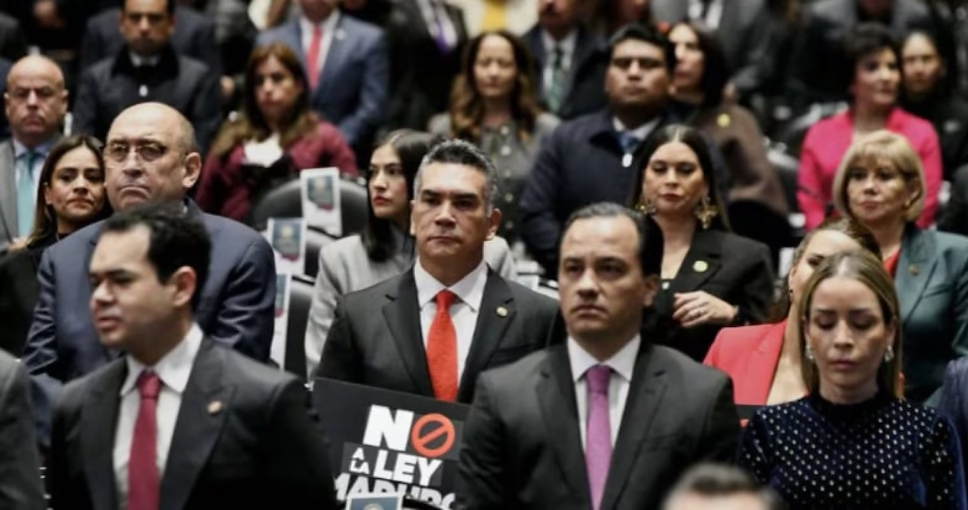
“Alito” Moreno accuses Morena of division and overwhelmed government

PRI leader Alejandro Moreno assures that the change in Morena reveals a deep division and an incapable government.

The PRI sees cracks in Morena and launches darts

Alejandro “Alito” Moreno, the national leader of the PRI, wasted no time. As soon as the second period of sessions was established in the Senate, he was already releasing bait. Their objective: the party in power.

According to him, the recent change in the coordination of the Morenoist caucus is not a simple adjustment. It is irrefutable proof of a deep internal division. Lack of coordination, lack of responsibility to put the country first. That’s your diagnosis.

RelatedAlito Moreno accuses the Morena government of protecting narcopoliticians

But “Alito” didn’t stop there. He upped the ante and dropped the qualifiers. He called the Morena government “incapable” and “exceeded”. Their argument: there are no results in security or economics.

“It is clear that they bent the government, they bent it,” the PRI senator forcefully stated.

For him, the ruling party has simply failed in its leadership. A direct, sharp message that seeks to mark the field from the first day of the new legislative period. The opposition seems to come with boxing gloves on.

Canicula 2025: dates, regions and effect of El Niño in Mexico

The heatwave will arrive in July; El Niño could intensify the heat and reduce rain.

Canicula 2025: dates, regions and effect of El Niño in Mexico

With the official start of the rainy season, a common question resurfaces: when does the heat wave arrive? This period, the driest and hottest of the year, is characterized by clear skies, less precipitation and high solar radiation.

According to the National Meteorological Service (SMN) of Conagua, the heatwave occurs between July and August, in the middle of the rainy season. It does not have an exact date, but it usually begins after the summer solstice (June 21). For this 2025, it is expected to start in the second week of July.

Possible influence of El Niño

This year, the El Niño phenomenon could alter the behavior of rainfall. According to Meteored, El Niño is estimated to last until spring 2027. Its presence could reduce precipitation and increase temperatures from the dog days to autumn.

Most affected states

The most exposed regions are Veracruz, Tabasco, Tamaulipas, Nuevo León, San Luis Potosí, Colima, Michoacán, Guerrero, Oaxaca and Chiapas. In these areas, temperatures can exceed 37 °C.

In contrast, states such as Zacatecas, Aguascalientes, Coahuila, Querétaro and Mexico City will not suffer the direct impact of the “veranillo”, according to the National Center for Disaster Prevention (Cenapred).

The name “dog days” comes from the constellation Canis Major, as the Romans believed that the heat of the sun added to that of the star Sirius, increasing the temperature in summer.

Continue reading

CNTE: protest thins out but mobilizations continue

Despite the reduction of camps, the CNTE maintains its protest in the Zócalo.

Mobility and divisions in the CNTE sit-in

15 days before the national strike, the presence of the National Coordinator of Education Workers (CNTE) in the streets of the Zócalo has decreased significantly. In streets like Madero, the road has practically been freed for pedestrian crossing, unlike the first days of the sit-in.

Other areas such as Simón Bolívar, 5 de Mayo and Isabel la Católica also register fewer blockades. Although there are still tents, vehicular traffic is now possible in some points. However, in Tacuba, Ignacio Allende and Donceles the presence is greater, with more robust camps, although not comparable at the beginning.

In the Republic of Cuba, Palma Norte and Belisario Domínguez, the kitchens and dining rooms of the teaching profession are concentrated. Here the tents still crowd the roads. But even at that point, some members began to pack their belongings to leave, according to this medium.

Internal divisions have arisen due to teacher fatigue. On June 12, the National Representative Assembly moved forward amid discussions and signs of wear. While some contingents proposed withdrawing, others insisted on maintaining pressure.

Despite everything, the CNTE has announced that it will continue with its mobilization days. These began with the release of access booths to the capital and in states where they have a greater presence.

Continue reading

Sheinbaum reports 274 thousand homes under construction

274 thousand homes under construction; six-year goal of 1.8 million.

Progress of the Housing for Wellbeing program

President Claudia Sheinbaum reported that 274 thousand houses are under construction throughout the country, as part of the Housing for Well-being program. Currently, the scheme serves 6.8 million families.

“Today housing is accessible for construction workers, for women who earn a minimum wage and who paid very high rents.”

The six-year goal is to build 1.8 million homes. Contracts, properties and projects of 604 thousand are already ready; Of them, 274 thousand are built.

Economic impact and employment

Sheinbaum highlighted that the program boosts the economy through the construction industry. For each house or apartment, three to four jobs are generated.

The Secretary of Agrarian, Territorial and Urban Development, Edna Elena Vega Rangel, pointed out that progress is 33% in the housing goal. It benefits 2.1 million people, through Conavi and Infonavit.

In addition, there is 32.2% progress in the delivery of support or credits for housing improvements: 579 thousand beneficiaries, equivalent to two million people.

Legal certainty and credits

The federal government has delivered 293 thousand deeds, settlement certificates and credit cancellations. This represents 29.3% of the six-year goal, benefiting one million families.

Infonavit and Fovissste have restructured, reduced balances and interest rates on 5.1 million loans.

Sheinbaum was accompanied at the event by: the executive member of Fovissste, Jabnely Maldonado Meza; the general directors of Infonavit (Octavio Romero Oropeza), Conavi (Rodrigo Chávez Contreras) and Insus (Víctor Rubén Guzmán Dagnino); the head of Profeco, César Iván Escalante Ruiz; and the political advisor Alfonso Suárez del Real.

Continue reading