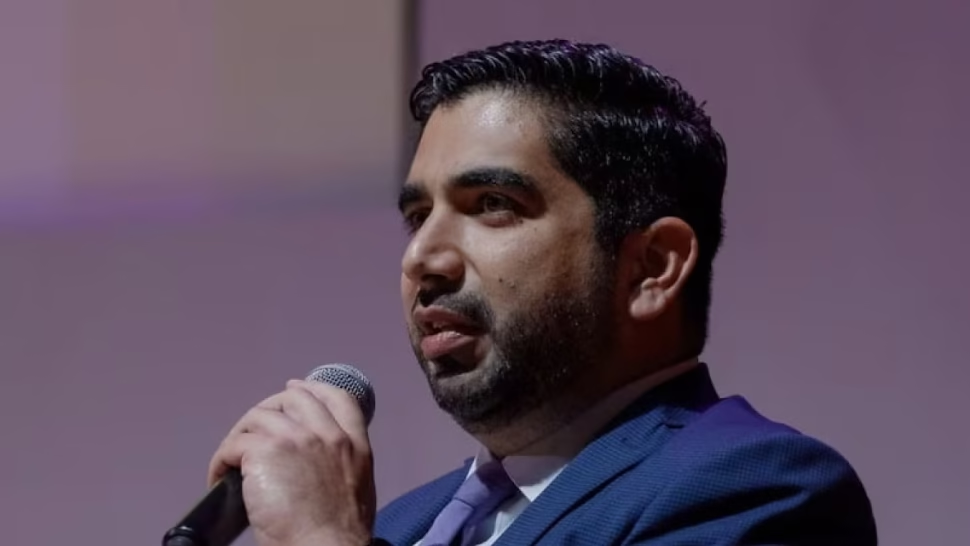
Advances in the case of the murder of Carlos Manzo

Authorities hope to bring the detainees to trial, after a joint investigation that is progressing quickly and transparently.

Strategic Coordination in Homicide Investigation

The Governor of Michoacán, Alfredo Ramírez Bedolla, has highlighted the significant progress in the investigations related to the homicide of the independent mayor Carlos Alberto Manzo Rodríguez. The state president highlighted a fundamental element for the progress of the case: the close collaboration between his administration, the State Attorney General’s Office and the Secretariat of Security and Citizen Protection of the federal government, headed by Omar García Harfuch. This inter-institutional synergy has been described as the cornerstone that has allowed us to obtain timely and accurate results in highly complex research. The articulation of efforts has facilitated the deployment of multiple lines of investigation, all characterized, according to the governor, by maximum transparency and high responsibility on the part of the Public Ministry.

This joint work is not limited to tax work, but extends to a crucial component of strategic intelligence. The State Prosecutor’s Office works in conjunction with the Secretariat of Public Security of Michoacán to analyze information, cross-reference data and generate solid evidence. This comprehensive approach, which combines traditional investigation with modern intelligence collection and analysis techniques, has been vital in unraveling the threads of a case involving alleged members of organized crime. The strategy not only seeks to clarify the facts, but also to dismantle the criminal networks that could have infiltrated the mayor’s security circles.

RelatedProgress in the investigation of the murder of Mayor Carlos Manzo

Involved and Next Procedural Steps

The authorities have managed to arrest eight individuals directly linked to the crime. Among them is Jorge Armando “N”, alias “El Licensed” or “El Contador”, who is identified as the alleged intellectual or material author of the attack. The other seven detainees made up the first security circle and escorts of Mayor Manzo Rodríguez. The central hypothesis of the investigation, which is in a very advanced phase, postulates that this protection group could have been penetrated or co-opted by the organized crime structure, which would have facilitated the execution of the homicide. Governor Ramírez Bedolla expressed his total confidence that all the accused will be brought to trial, with the precautionary measure of preventive detention.

The president publicly recognized the trust placed by the Carlos Manzo family in the institutions, a factor that has been well received and that, in his opinion, drives a more timely response. Unlike other investigative processes that can last for months without concrete results, this case has demonstrated the effectiveness of a reinforced coordination mechanism. Following a request from the defense of those involved, a doubling of the constitutional deadline was granted for the initial hearing. This Wednesday, a control judge will formally determine whether or not there is sufficient basis to link the eight detainees to trial, a crucial moment that will define the judicial direction of this emblematic case of political violence.

Do you think this type of inter-institutional collaboration is important to combat crime? Share this news on your social networks and help us make security developments visible. To stay informed with in-depth analysis on justice and politics issues, explore more related content on our portal.
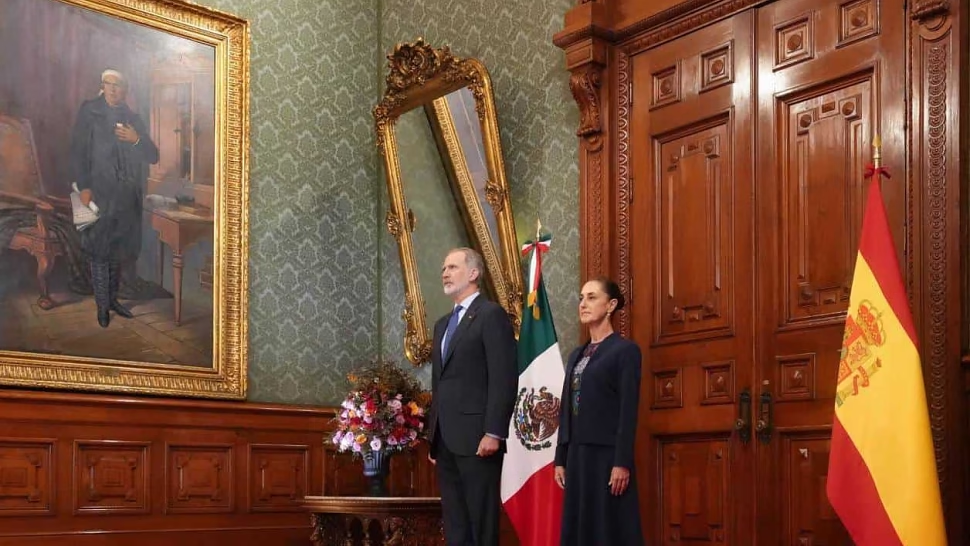
Mexico receives King Felipe VI with honors at the National Palace

Sheinbaum and the Spanish monarch discuss the bilateral relationship in the National Palace.

Welcome ceremony at the National Palace

President Claudia Sheinbaum Pardo received King Felipe VI of Spain this day in the Ambassadors Room of the National Palace. During the official ceremony, the national anthems of both countries were sung, followed by the official photograph of the meeting.

Bilateral meeting

Sheinbaum and the monarch will hold a dialogue about the state of the relationship between Mexico and Spain. Senior officials from both governments attend the meeting.

On behalf of Mexico: the Secretary of Foreign Affairs, Roberto Velasco Álvarez; the head of the Office of the Presidency, Lázaro Cárdenas Batel; and the Mexican ambassador to Spain, Quirino Ordaz Coppel.

For Spain: the Minister of Foreign Affairs, European Union and Cooperation, José Manuel Albares Bueno; the Minister of Education, Vocational Training and Sports, Milagros Tolón Jaime; the head of the King’s House, Camilo Villarino Marzo; the ambassador of Spain in Mexico, Juan Duarte Cuadrado; the diplomatic advisor of the King’s House, Carmen Castiella Ruiz de Velasco; and the head of the Minister’s Office, Sergio Cuesta Francisco.

The visit of King Felipe VI takes place within the framework of his official tour of Mexican territory. Both leaders are expected to address issues of cooperation, trade and culture.

Continue reading

Passenger trains: Mexico City-Querétaro and Pachuca would start in 2027

Federal government advances in six passenger train routes; two would begin operations in 2027.

Advances in the passenger and freight railway network

President Claudia Sheinbaum reported that the construction of passenger trains is advancing significantly. The Mexico City-Querétaro and Mexico City-Pachuca routes will be inaugurated in 2027, while other lines such as Saltillo-Nuevo Laredo and Querétaro-Irapuato continue to be developed.

“We are very advanced. The other sections to Guadalajara and Nuevo Laredo will be put out to tender this year or carried out by the Ministry of Defense,” he stated during the morning conference. The complete project includes an investment of 750 billion pesos.

Right of way and community work

Edna Elena Vega Rangel, Secretary of Agrarian Development, reported that 28 million 452 thousand 804 square meters of right of way have been released. Of that total, 72% corresponds to historical right of way, 14% to social property and 14% to private property. To serve the communities, 268 social tables were held, 95 assemblies with more than 4,500 attendees and 987 plots were acquired.

Andrés Lajous, head of the Train Agency, explained that clearings, embankments and drainage works are being carried out on the Querétaro-Irapuato and Saltillo-Nuevo Laredo sections. In Monterrey, 30 thousand tons of steel are already manufactured and 9-kilometer viaduct projects are being developed. In addition, the manufacturing of sleepers began: 330 thousand for Querétaro-Irapuato, 430 thousand for Saltillo-Monterrey and 490 thousand for Monterrey-Nuevo Laredo.

Tenders and first trains

Phase 2 of bidding for the Mexico City-Saltillo and San Luis Potosí-Saltillo sections began. Six stations, three auxiliary buildings and maintenance bases will be put out to tender. The first AIFA-Pachuca train will arrive in Mexico on July 25 and this month the construction of the first unit of the northern trains begins.

In the metropolitan area of ​​Querétaro, three vehicular underpasses, four overpasses and 11 pedestrian overpasses are considered, among other works.

Participation of the Sedena and progress by section

General Gustavo Ricardo Vallejo Suárez reported that 33,072 personnel participate in railway work, of which 6,380 are women, with 7,000 units of machinery. Nearly 800 kilometers of basic engineering have been developed in the first four sections.

The specific advances are: Mexico City-Pachuca at 37.06% (121 km of new roads, 10 km of viaducts, 10 work fronts); Mexico City-Querétaro at 19.22% (232.42 km, 14 fronts).

As for the Mayan cargo train, it reaches 54.05% progress. Intermodal complexes are built in Palenque, Mérida, Progreso and Cancún. A multimodal complex is planned for 2027 in Chetumal and five operations yards.

Néstor Núñez, from the SICT, indicated that the stations and auxiliary buildings are advancing, and 26 social attention tables and 36 techniques have been made to explain the coexistence of the train with the environment.

Continue reading

Roberto Lazzeri begins management as ambassador with call for cooperation

The diplomat participated in a Trump event where a 66% reduction in fentanyl was reported.

First public intervention

Roberto Lazzeri participated this Wednesday in his first public event as Mexican ambassador to the United States. It was during an event organized by Donald Trump on the National Mall for the 250th anniversary of American independence.

There he heard the message from President Trump, who highlighted a 66% reduction in the flow of fentanyl into his country. Lazzeri pointed out that these results strengthen bilateral security cooperation, promoted by President Claudia Sheinbaum based on respect for sovereignty and coordination.

A 35% decrease in overdose deaths in the United States was also mentioned, as well as the seizure of nearly 30,000 firearms. The ambassador attributed these figures to the joint work between both nations.

Trump used the event to refer to the 2026 FIFA World Cup, which will be played in North America. Lazzeri assured that Mexico contributes to the project with actions in security, connectivity and tourism, with an estimated economic benefit of more than 18 billion pesos.

Continue reading