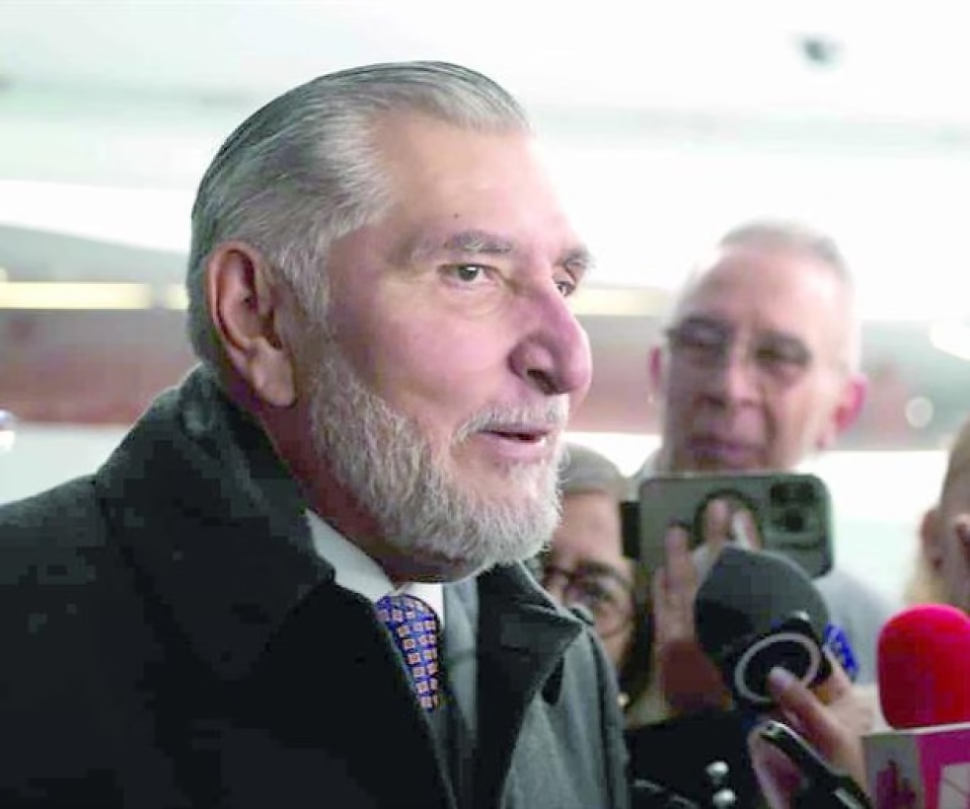
Adán Augusto reveals the origin of Salinas Pliego’s fortune

The senator reveals the origins of a fortune and faces a media onslaught with compelling data about his business past.

A Revelation that Changes the Rules of the Game

Hello, transforming family! Today I want to share with you a story of courage and truth that shows us the incredible power we have when we decide to speak out. Senator Adán Augusto López Hernández is giving us a master lesson on how to face challenges with our heads held high, exposing what he describes as an orchestrated campaign of attacks. And you know what? This inspires us to never remain silent in the face of adversity, because every time we defend our truth, we are building a more transparent future.

Imagine the energy it takes to directly point out a figure like Ricardo Salinas Pliego, accusing him of being behind the attacks coming from sectors of the ultra-right. This is not just politics; It is a call to wake up and question the narratives that surround us. In his statements, Adam Augustus did not limit himself to defending himself, but went further! He stated that the businessman took over channel 40 and acquired TV Azteca using resources from the so-called secret party of the Presidency of the Republic, funds that, according to him, came from Raúl Salinas, brother of former president Carlos Salinas de Gortari. Every detail that comes to light is an opportunity to reflect on integrity and the power of honesty!

RelatedFox supports the possible presidential candidacy of Salinas Pliego

The Force of Truth and Collective Memory

In the face of what he describes as a campaign of lies, the senator made a passionate call: the people of Mexico deserve to know the reality about how that television station was acquired. He affirms with conviction that ADN was one more of the Salinas Pliego robberies, and that channel 40 was transformed into what we know today as ADN 40. Isn’t it amazing how a single voice can trigger a wave of awareness? He even invited figures such as Denise Maerker and Ciro Gómez Leyva to ask about the takeover of facilities in Chiquihuite, highlighting the importance of remembering our history so as not to repeat it.

Adan Augusto described this situation as an onslaught from the extreme right, but with contagious optimism, he assured that the people will not fall into the farce mounted by what he calls an “eccentric millionaire.” On the contrary, it invites us all to act! Its message is clear: we must disseminate the origin of fortunes and the size of contracts, because transparency is the key to transformation. He emphasizes that many have forgotten how that television channel was bought with secret funds, and even mentions that the memory of Raúl Salinas has faded. This reminds us that each of us has the power to keep the truth alive and use it as an engine for change.

But the inspiration doesn’t stop there. The senator also connected the Latinus reports against him with the pain of Roberto Madrazo over the loss of contracts in multiple states. For years, Adán Augusto has denounced what he defines as the health cartel, showing how some profit from basic needs. What an example of perseverance! In addition, he acknowledged knowing the shipping businessman Juan Pablo Vega Arriaga, allegedly linked to a shipment of huachicol, demonstrating that facing reality, no matter how hard it may be, is the first step towards renewal and justice.

Friends, this story is not just about accusations; It is a reminder that every time someone chooses honesty over silence, we are closer to a world where integrity shines brighter than opacity. Let’s take advantage of this energy to fuel our own struggles, remembering that obstacles are only stepping stones to our growth. Change begins with a single brave step!

Were you inspired by this story of transformation and truth? Share it on your social networks so that more people join this conversation and together we explore more content that awakens our potential! 💫 #Transformation #TruthAndPower

Canicula 2025: dates, regions and effect of El Niño in Mexico

The heatwave will arrive in July; El Niño could intensify the heat and reduce rain.

Canicula 2025: dates, regions and effect of El Niño in Mexico

With the official start of the rainy season, a common question resurfaces: when does the heat wave arrive? This period, the driest and hottest of the year, is characterized by clear skies, less precipitation and high solar radiation.

According to the National Meteorological Service (SMN) of Conagua, the heatwave occurs between July and August, in the middle of the rainy season. It does not have an exact date, but it usually begins after the summer solstice (June 21). For this 2025, it is expected to start in the second week of July.

Possible influence of El Niño

This year, the El Niño phenomenon could alter the behavior of rainfall. According to Meteored, El Niño is estimated to last until spring 2027. Its presence could reduce precipitation and increase temperatures from the dog days to autumn.

Most affected states

The most exposed regions are Veracruz, Tabasco, Tamaulipas, Nuevo León, San Luis Potosí, Colima, Michoacán, Guerrero, Oaxaca and Chiapas. In these areas, temperatures can exceed 37 °C.

In contrast, states such as Zacatecas, Aguascalientes, Coahuila, Querétaro and Mexico City will not suffer the direct impact of the “veranillo”, according to the National Center for Disaster Prevention (Cenapred).

The name “dog days” comes from the constellation Canis Major, as the Romans believed that the heat of the sun added to that of the star Sirius, increasing the temperature in summer.

Continue reading

CNTE: protest thins out but mobilizations continue

Despite the reduction of camps, the CNTE maintains its protest in the Zócalo.

Mobility and divisions in the CNTE sit-in

15 days before the national strike, the presence of the National Coordinator of Education Workers (CNTE) in the streets of the Zócalo has decreased significantly. In streets like Madero, the road has practically been freed for pedestrian crossing, unlike the first days of the sit-in.

Other areas such as Simón Bolívar, 5 de Mayo and Isabel la Católica also register fewer blockades. Although there are still tents, vehicular traffic is now possible in some points. However, in Tacuba, Ignacio Allende and Donceles the presence is greater, with more robust camps, although not comparable at the beginning.

In the Republic of Cuba, Palma Norte and Belisario Domínguez, the kitchens and dining rooms of the teaching profession are concentrated. Here the tents still crowd the roads. But even at that point, some members began to pack their belongings to leave, according to this medium.

Internal divisions have arisen due to teacher fatigue. On June 12, the National Representative Assembly moved forward amid discussions and signs of wear. While some contingents proposed withdrawing, others insisted on maintaining pressure.

Despite everything, the CNTE has announced that it will continue with its mobilization days. These began with the release of access booths to the capital and in states where they have a greater presence.

Continue reading

Sheinbaum reports 274 thousand homes under construction

274 thousand homes under construction; six-year goal of 1.8 million.

Progress of the Housing for Wellbeing program

President Claudia Sheinbaum reported that 274 thousand houses are under construction throughout the country, as part of the Housing for Well-being program. Currently, the scheme serves 6.8 million families.

“Today housing is accessible for construction workers, for women who earn a minimum wage and who paid very high rents.”

The six-year goal is to build 1.8 million homes. Contracts, properties and projects of 604 thousand are already ready; Of them, 274 thousand are built.

Economic impact and employment

Sheinbaum highlighted that the program boosts the economy through the construction industry. For each house or apartment, three to four jobs are generated.

The Secretary of Agrarian, Territorial and Urban Development, Edna Elena Vega Rangel, pointed out that progress is 33% in the housing goal. It benefits 2.1 million people, through Conavi and Infonavit.

In addition, there is 32.2% progress in the delivery of support or credits for housing improvements: 579 thousand beneficiaries, equivalent to two million people.

Legal certainty and credits

The federal government has delivered 293 thousand deeds, settlement certificates and credit cancellations. This represents 29.3% of the six-year goal, benefiting one million families.

Infonavit and Fovissste have restructured, reduced balances and interest rates on 5.1 million loans.

Sheinbaum was accompanied at the event by: the executive member of Fovissste, Jabnely Maldonado Meza; the general directors of Infonavit (Octavio Romero Oropeza), Conavi (Rodrigo Chávez Contreras) and Insus (Víctor Rubén Guzmán Dagnino); the head of Profeco, César Iván Escalante Ruiz; and the political advisor Alfonso Suárez del Real.

Continue reading